If you are scoping optics for an AI cluster going live in 2026 or 2027, the question is no longer “400G or not” — it is whether to skip 400G entirely and start at 800G. The right answer depends on three numbers most procurement decks under-emphasize: cost per gigabit, watts per gigabit, and switch silicon roadmap. This guide gives a procurement-grade framework, a side-by-side comparison, and the decision rules ABPTEL uses with our data center clients today.
⚡ TL;DR — Should you buy 400G or 800G in 2026?
- Buy 400G if your switch fabric is Tomahawk 4 / Spectrum-3 class, your reach is < 2 km, and you need to deploy in the next 60 days. 400G QSFP-DD is mature, in-stock, and ~30% cheaper per Gbps than 800G today.
- Buy 800G if you are spec’ing a new AI training cluster (H100 / H200 / GB200 class), have Tomahawk 5 or Spectrum-4 switching, and your CapEx model amortizes over 4+ years. 800G OSFP delivers ~25% lower watts/Gbps and future-proofs your spine for the 1.6T transition.
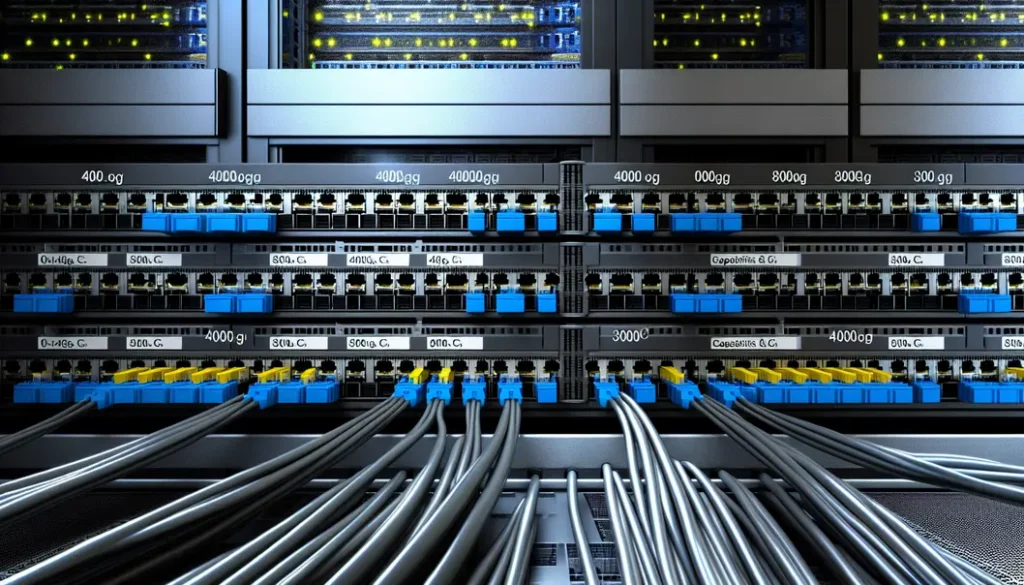
- Mix 400G + 800G in spine-leaf where leaf-to-server is 400G AOC/DAC and spine-to-spine is 800G — the most common 2026 deployment pattern for hyperscale AI clusters.
Quick comparison: 400G vs 800G at a glance
| Dimension | 400G (QSFP-DD / OSFP) | 800G (OSFP / QSFP-DD800) |
|---|---|---|
| Per-port cost (2026 Q2) | $650 – $1,400 | $1,400 – $2,800 |
| Cost per Gbps | $1.6 – $3.5 | $1.7 – $3.5 |
| Power draw | 9 – 14 W | 14 – 18 W |
| Watts per Gbps | 0.022 – 0.035 | 0.017 – 0.022 ✅ |
| Modulation | PAM4 (8×50G or 4×100G) | PAM4 (8×100G) |
| Form factors | QSFP-DD, OSFP | OSFP, QSFP-DD800 |
| Switch silicon required | Tomahawk 4, Spectrum-3 | Tomahawk 5, Spectrum-4, Jericho 3-AI |
| Typical reach (SMF) | 500 m – 40 km | 500 m – 10 km (longer reach in roadmap) |
| Lead time (ABPTEL) | Stock to 2 weeks | 4 – 8 weeks |
| Best fit | Spine-leaf, server access, mature DC | AI training fabrics, hyperscale spine, new builds |
When to choose 400G
400G QSFP-DD is the workhorse of 2024–2026 data center deployments. It hits the sweet spot of cost, ecosystem maturity, and broad switch compatibility. If you are building or expanding a non-AI data center — cloud, enterprise, or carrier — 400G is almost always the right answer in 2026.
- Your switching silicon is Broadcom Tomahawk 4 (12.8 Tbps) or NVIDIA Spectrum-3.
- You need to deploy within 30–60 days — 400G QSFP-DD has the broadest stocked supply.
- Your reach requirements span 500 m (DR4) to 40 km (ER4) — 400G covers all of these standards mature.
- You want to amortize over a shorter window (2–3 years) before refreshing.
- Your interop matrix includes legacy 100G QSFP28 — 400G QSFP-DD is mechanically backward-compatible.
When to choose 800G

800G is the right choice when your workload is AI training and your switch fabric supports Tomahawk 5 (51.2 Tbps) or Spectrum-4. The watts-per-gigabit advantage compounds across thousands of ports — for a 4,000-port AI cluster, 800G saves roughly 60–80 kW of cooling load versus an equivalent 400G fabric.
- You are building an AI training cluster around H100 / H200 / GB200 / MI300 GPUs.
- Your switch silicon is Tomahawk 5, Spectrum-4, or Jericho 3-AI.
- Your CapEx model amortizes over 4+ years — 800G future-proofs the spine before the 1.6T transition.
- Power and cooling are constrained — every 0.005 watts/Gbps matters at AI cluster scale.
- You can plan a 4–8 week lead time and prefer fewer, fatter pipes (800G OSFP can break out into 2× 400G or 8× 100G).
Cost and power: where the real difference is

On a per-port basis, 800G optics cost roughly 2× of 400G in 2026. On a per-gigabit basis, the gap closes to under 5%. That sounds like 800G is the obvious winner — but two real-world factors flip the math:
- Switch port amortization. A Tomahawk 5 switch costs ~1.6× of a Tomahawk 4. If you cannot fully populate the 800G ports, your effective cost per used Gbps spikes.
- Optical reach mismatch. 800G FR4 / DR4 optics today max out around 2 km. If your spine-to-spine link is 5 km, you are forced to either deploy long-reach 800G (~2× the cost of 800G DR4) or split into 2× 400G LR4. Many AI clusters fall into this trap.
“For most enterprise and cloud workloads, 400G is still the rational 2026 choice. 800G earns its premium only when you have AI training scale and the switching silicon to use every port.”
— Candy, ABPTEL Data Center Optics Team
Form factors: QSFP-DD vs OSFP — does it matter?
For 400G, both QSFP-DD and OSFP are mature. QSFP-DD is mechanically backward-compatible with QSFP28 and dominates Broadcom Tomahawk 4 deployments. OSFP has slightly better thermal headroom and dominates AI workloads where power dissipation matters.
For 800G, OSFP is the dominant form factor for AI training fabrics. NVIDIA Spectrum-X and most Quantum InfiniBand switches use OSFP. QSFP-DD800 exists but is most common in cloud / hyperscale Ethernet rather than AI training.
⚠️ Common procurement trap
Mixing OSFP and QSFP-DD800 in the same fabric is technically possible but creates a service nightmare for spare-part SKUs and field replacement. Pick one form factor per fabric and stick with it. If you are unsure, default to OSFP for AI clusters and QSFP-DD for non-AI cloud.
A 5-step decision framework
- What is the switch silicon? Tomahawk 4 / Spectrum-3 → 400G. Tomahawk 5 / Spectrum-4 / Jericho 3-AI → 800G.
- What is the workload? AI training (GPU-to-GPU) → 800G OSFP. Cloud / enterprise / carrier → 400G QSFP-DD.
- What is the deployment timeline? < 60 days → 400G (better stock). 3–6 months → 800G is feasible.
- What is the longest link? < 2 km → both work. 2–10 km → 400G LR4 is mature; 800G long-reach is still expensive. > 10 km → 400G ER4 / ZR.
- What is the amortization window? < 3 years → 400G. 4+ years → 800G future-proofs against 1.6T.
Frequently asked questions
Is 800G backward compatible with 400G?
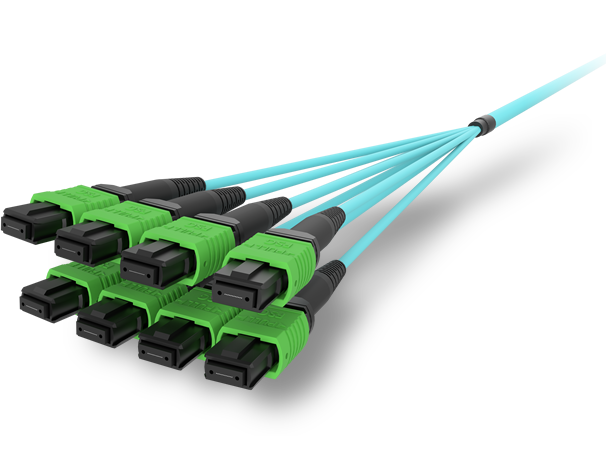
Yes, with breakout. An 800G OSFP-DR8 module breaks out into 2× 400G DR4 (or 8× 100G DR1) using MPO breakouts. This is a common pattern for spine-to-leaf fan-out in AI fabrics.
Can I run 400G in an 800G port?
On QSFP-DD800 ports, yes — they are backward compatible with QSFP-DD 400G. On OSFP 800G ports, you need an OSFP-to-QSFP56-DD adapter, which adds cost and slight latency. Most 800G AI deployments stay native.
What is the lead time for 800G optics in 2026?
Industry-wide, 4–10 weeks depending on form factor and reach. ABPTEL holds stock on the most common 800G OSFP SKUs (DR4, FR4, 2×DR4, 2×FR4) with typical lead time of 4–6 weeks. Contact Candy for current stock and pricing.
Will 800G be obsolete by 2027?
No. 1.6T optics are roadmapped for 2027–2028 production but will not be widely deployed before 2029. 800G has a clear 4–5 year deployment runway, especially in AI training where current GPU NICs are already 800G capable.
Is QSFP-DD800 a real product or just a roadmap?
It is shipping in 2026 from major vendors but has lower volume than OSFP 800G. Mechanical backward compatibility with QSFP-DD 400G is its main appeal for cloud operators with installed Tomahawk 4 fleets transitioning to Tomahawk 5.
Source 400G & 800G optics from ABPTEL
ABPTEL ships 400G QSFP-DD and 800G OSFP optical transceivers from Shenzhen with OEM/ODM support for Cisco, Arista, Juniper, NVIDIA, and Mellanox compatibility. Our engineering team can provide pre-sales compatibility validation and bulk pricing for AI cluster deployments of 100+ ports.
- 🔥 Browse 400G & 800G transceivers — full catalog with compatibility notes
- 📡 AOC & DAC cables — short-reach GPU cluster interconnects
- 🧩 MPO/MTP breakout cables — required for 800G → 2×400G fan-out
- 📋 Data center cabling design guide — end-to-end planning support
💬 Get a quote in 12 hours: Contact Candy · WhatsApp +86 188 1445 5697 · candy@abptel.com
Talk to ABPTEL
Looking for the right optical hardware for your AI data center, GPU cluster, or FTTA project? ABPTEL ships from Shenzhen with OEM/ODM support, fast lead times, and engineering-level pre-sales advice.
- 🔥 400G & 800G OSFP / QSFP-DD Transceivers — for AI training fabrics and hyperscale spine-leaf
- 📡 MPO / MTP High-Density Cabling — 12 / 24 / 32-fiber for high-density data centers
- ⚡ AOC & DAC Cables — short-reach GPU interconnects, OEM compatible
- 🧩 SFP / SFP+ / SFP28 / QSFP28 Modules — 1G to 100G optical transceivers
- 📋 Data Center Cabling Solutions — end-to-end design guide
- ❓ Read our FAQ — compatibility, polarity, lead time, MOQ
💬 Get a quote in 12 hours: Contact Candy · WhatsApp +86 188 1445 5697 · candy@abptel.com