
Solution · Telecom & Power
ADSS and OPGW Fiber Cable for Telecom and Power Lines
Aerial fiber cable for carriers, ISPs and utilities: ADSS for poles and existing towers, OPGW for the ground-wire position on high-voltage lines.
Which cable fits your line?
| ADSS | OPGW | |
|---|---|---|
| Full name | All-Dielectric Self-Supporting | Optical Ground Wire |
| Metal content | None, fully dielectric | Aluminum-clad steel or aluminum alloy strands |
| Where it hangs | Utility poles, or below the conductors on power towers | Top of the tower, replacing the overhead ground wire |
| Main job | Fiber communication only | Lightning shielding and fault-current grounding, plus fiber |
| Typical use | Telecom routes, retrofits on live power lines | New or re-strung 110 kV to 500 kV transmission lines |
| Fiber type | G.652D or G.655 single-mode | G.652D or G.655 single-mode |
Rule of thumb: if the line is already built and the conductors stay live, ADSS is usually easier to install. If the ground wire is being replaced or the line is new, OPGW does both jobs in one cable.
What to send us for a quote
01
Line voltage
For ADSS on power towers this decides between a PE sheath and an anti-tracking (AT) sheath.
02
Span and sag
Maximum span between poles or towers, plus ice and wind load for your region.
03
Fiber count
Current need plus spare fibers for future expansion.
04
Fault current (OPGW)
Short-circuit current and duration the ground wire must carry.
ADSS cable
ADSS is strong enough to support itself between poles or towers without a metal messenger. With no conductive parts, it can run alongside high-voltage conductors without electrical interference.
- Loose-tube design with aramid or glass-yarn strength members
- Single or double jacket; PE for general outdoor use, AT sheath for 110 kV and above or polluted, humid areas
- Fiber counts from small cables up to 288 fibers
- Suspension and dead-end hardware can be quoted with the cable
Exact values depend on the cable design. We confirm them in the spec sheet for your order.
OPGW cable
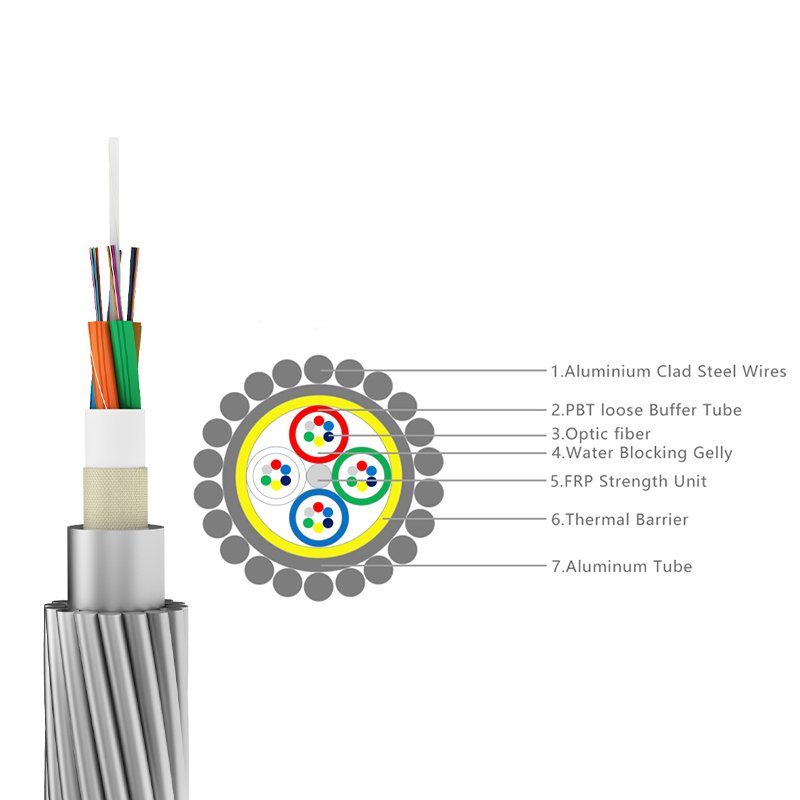
OPGW sits at the top of the tower. Its metal strands shield the line from lightning and carry fault current to ground, while the fibers inside run the utility’s communication and protection signals.
- Central stainless-steel tube or aluminum-clad PBT loose-tube designs
- Single or double layer of aluminum-clad steel (ACS) or ACS mixed with aluminum alloy wires
- Fiber counts typically 6 to 144
- Designed for the voltage, span and short-circuit rating of your line
Exact values depend on the cable design. We confirm them in the spec sheet for your order.
Related guides: ADSS vs OPGW: how to choose · ADSS accessories and hardware · OPGW specifications and standards
Frequently asked questions
Can ADSS be installed on a live power line?
Yes, that is one of its main uses, because the cable has no metal parts. On lines of 110 kV and above, or in polluted areas, specify an anti-tracking (AT) sheath.
What is the difference between G.652D and G.655 fiber?
G.652D is standard single-mode fiber for most networks. G.655 is non-zero dispersion-shifted fiber, used on some long-distance, high-capacity routes.
Do you supply hardware and accessories?
Suspension clamps, dead-end clamps and joint closures can be quoted together with the cable. Tell us the span and pole or tower type.
Get a free spec sheet & quote
Tell us the fiber count, length and connector. Candy, our fiber specialist, reviews every request.