SFP, QSFP, QSFP-DD & OSFP Cages: The 10G-to-800G Selection Guide
Cages and their connectors decide your port density, thermals and upgrade path. Here is how to choose the right pluggable form factor — and how press-fit, heat sinks and belly-to-belly stacking change the decision.
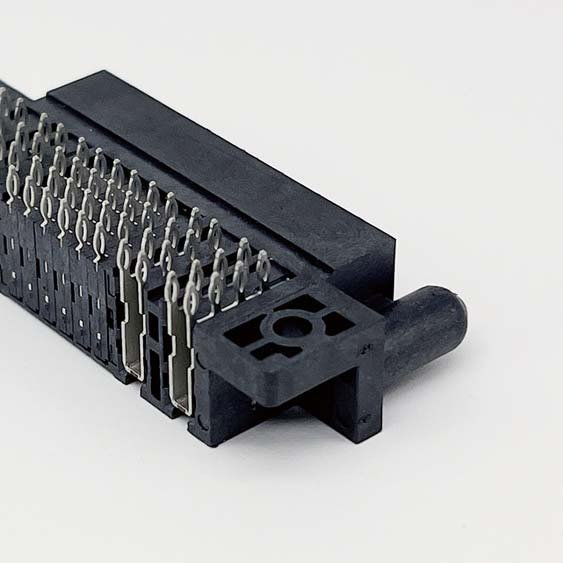
A pluggable cage is the shielded housing a transceiver or DAC plugs into; the connector behind it carries the signal onto the board. Pick the cage and you pick your speed ceiling, your port density and how hard your thermals will be.
The Form-Factor Ladder: SFP to OSFP
Every pluggable form factor is defined by lane count and lane speed:
| Form factor | Lanes | Speed | Where it lives |
|---|---|---|---|
| SFP / SFP+ | 1 | 1G–10G | Access, ToR uplinks |
| SFP28 | 1 | 25G | 25G server ToR |
| QSFP28 | 4 | 100G | Spine-leaf aggregation |
| QSFP-DD | 8 | 400G | 400G fabric (QSFP-compatible) |
| OSFP | 8 | 800G–1.6T | AI / GPU fabrics |
QSFP-DD cages → reuse the QSFP board footprint, so a 400G upgrade rarely needs a new layout. OSFP cages → are physically larger with more thermal headroom — the reason they dominate 800G AI builds.
Belly-to-Belly & Ganged Cages
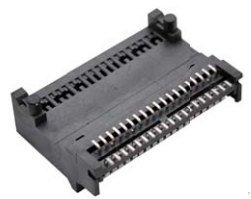
To fit more ports on the same panel, cages are ganged (1xN side by side) or stacked belly-to-belly (2xN, two rows). Stacking doubles density but concentrates heat and complicates the heat-sink design — which is why high-power 400G/800G ports often stay 1×1 with a dedicated heat sink. See ganged SFP+ cages →
Heat Sinks: Integrated vs Riding
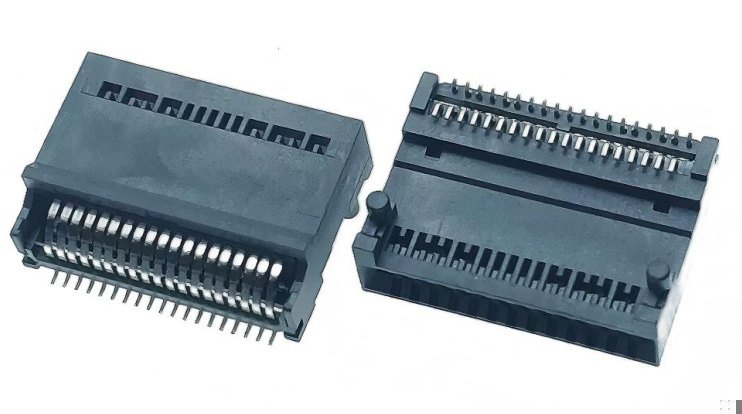
As optics pass ~12–15W, the cage is the cooling system. Two approaches: an integrated heat sink bonded to the cage, or a riding heat sink that floats on the module top for direct die contact. OSFP’s larger body is built around the riding-heat-sink approach, which is part of why it scales to 800G and beyond.
Press-Fit vs Solder-Tail Mounting
| Mounting | Best for | Trade-off |
|---|---|---|
| Press-fit | Thick backplanes, field rework | No reflow needed; taller stack |
| Solder-tail (SMT) | SMT line cards | Lowest profile; needs reflow |
Also confirm the EMI gasket (front-panel finger style) and whether you need a light pipe to route module LEDs to the panel.
Replacing TE, Molex & Amphenol
Cages and connectors are footprint-standardized, so a form-fit-function equivalent drops into an existing design. Send the original part number and confirm three things: footprint/pinout, mounting style (press-fit vs solder), and heat-sink/EMI options. A validated equivalent typically lands 30–50% below the name-brand price. Browse the full cage & connector range →
FAQ
Is QSFP-DD backward compatible with QSFP28?
OSFP or QSFP-DD for 800G?
Do you supply matching DAC and AOC cables?
Spec’ing a switch or line card?
Browse cages and connectors from 10G to 800G, or send your TE/Molex/Amphenol part numbers for a cross-reference quote.
Browse Cages & Connectors →Get a QuoteTalk to ABPTEL
Looking for the right optical hardware for your AI data center, GPU cluster, or FTTA project? ABPTEL ships from Shenzhen with OEM/ODM support, fast lead times, and engineering-level pre-sales advice.
- 🔥 400G & 800G OSFP / QSFP-DD Transceivers — for AI training fabrics and hyperscale spine-leaf
- 📡 MPO / MTP High-Density Cabling — 12 / 24 / 32-fiber for high-density data centers
- ⚡ AOC & DAC Cables — short-reach GPU interconnects, OEM compatible
- 🧩 SFP / SFP+ / SFP28 / QSFP28 Modules — 1G to 100G optical transceivers
- 📋 Data Center Cabling Solutions — end-to-end design guide
- ❓ Read our FAQ — compatibility, polarity, lead time, MOQ
💬 Get a quote in 12 hours: Contact Candy · WhatsApp +86 188 1445 5697 · candy@abptel.com