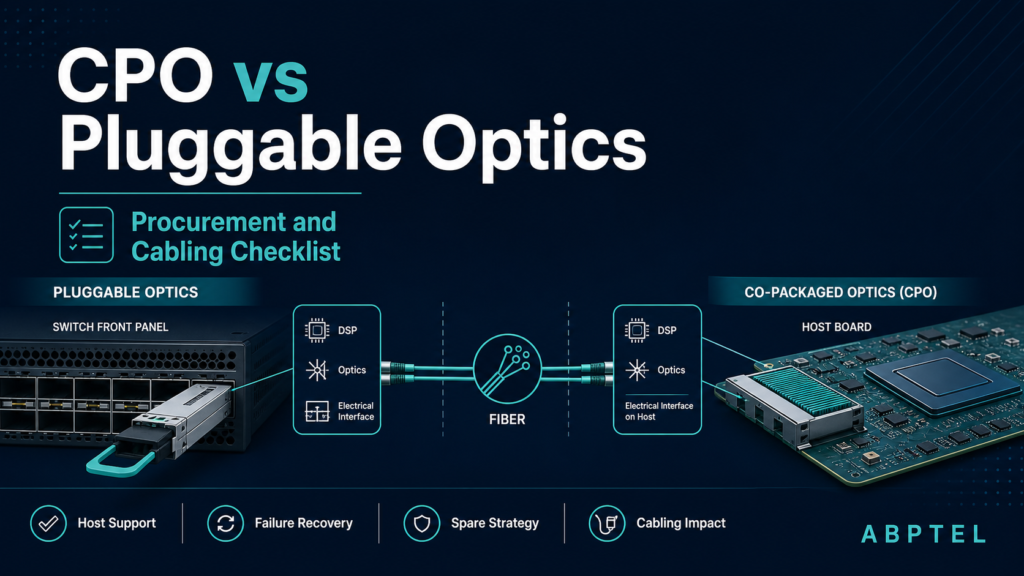
CPO vs Pluggable Optics: What Changes for Procurement and Cabling?
CPO is no longer a pure theory slide.
It is real roadmap technology, and the direction is easy to understand: move the optical engine closer to the ASIC to save power and improve density. But for 2026-2028 deployments, pluggable optics still remain the practical default for most buyers.
That is the point this article makes:
- CPO changes the way high-end AI systems are built.
- It does not remove the need for fiber, connectors, cleaning, polarity control, or installation discipline.
- It does not make pluggable 400G/800G optics obsolete in the next few project cycles.
If you buy optics, cabling, or high-density interconnects, the real question is not "Will CPO exist?" The real question is "What changes in procurement, and what still needs to be verified before I place the order?"
TL;DR
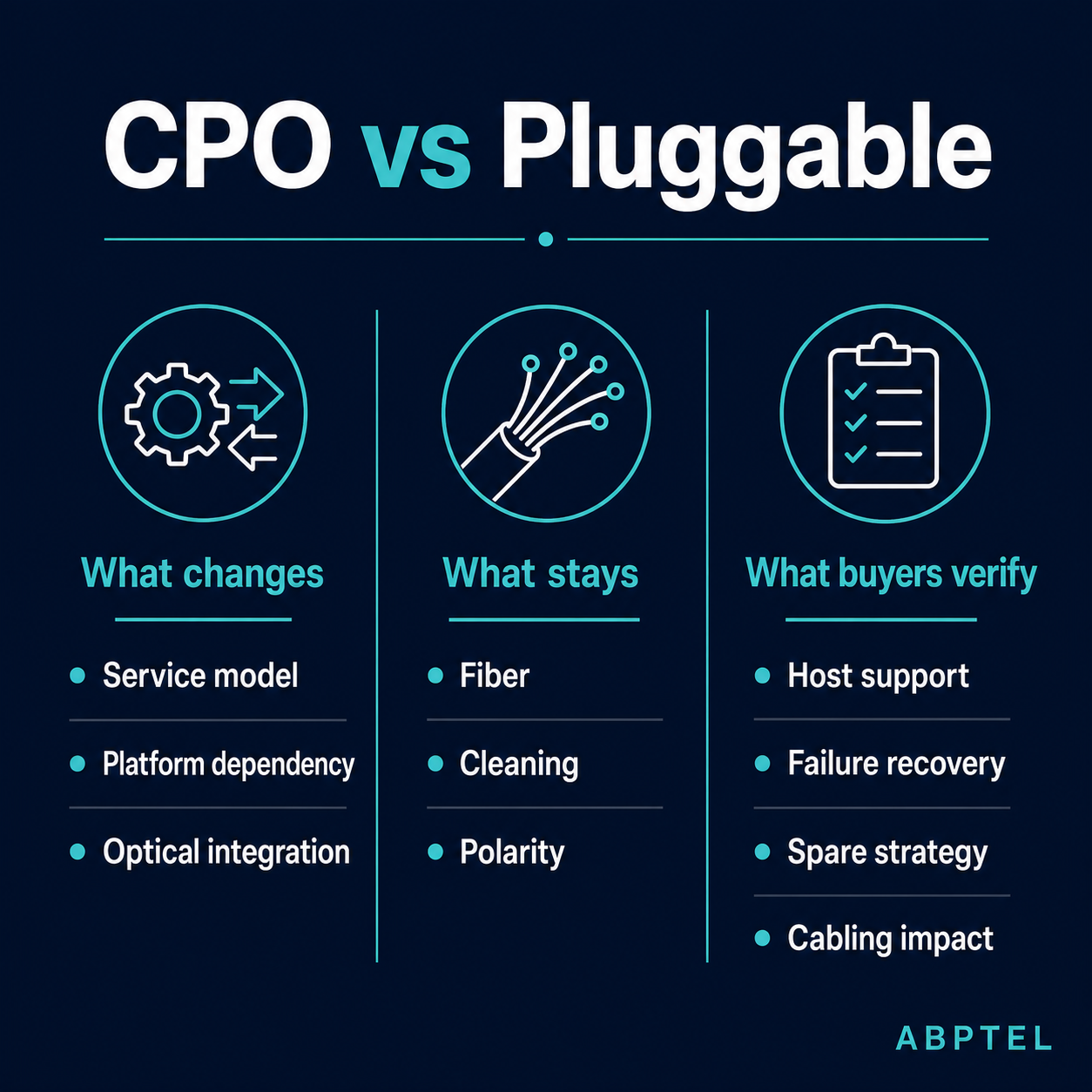
| Topic | What changes | What stays |
|---|---|---|
| Optical engine location | The optical function moves closer to the ASIC | Fiber plant still matters |
| Maintenance model | Service becomes more platform-dependent | Field replacement discipline still matters |
| Procurement scope | More attention on host platform and ecosystem lock-in | Compatibility checks still matter |
| Cabling design | New front-panel assumptions at the highest end | Cleaning, polarity, labeling and testing still matter |
| Timing | CPO grows on the roadmap | Pluggables stay dominant in near-term deployments |
For most 2026-2028 builds, the safest position is still:
- Standardize on pluggable 400G/800G where the project needs field serviceability.
- Treat CPO as a roadmap item, not an immediate replacement.
- Keep the fiber and test process ready for higher density, because that is where the migration pressure shows up first.
Why this matters now
Public vendor materials are pushing two messages at the same time:
- AI Ethernet continues to scale, and validated system stacks are becoming more important.
- Power and density pressure are pushing the industry toward tighter optical integration.
That means buyers are now hearing about both 800G deployment and next-step photonics in the same planning cycle.
The mistake is to read that as an immediate replacement story.
It is not.
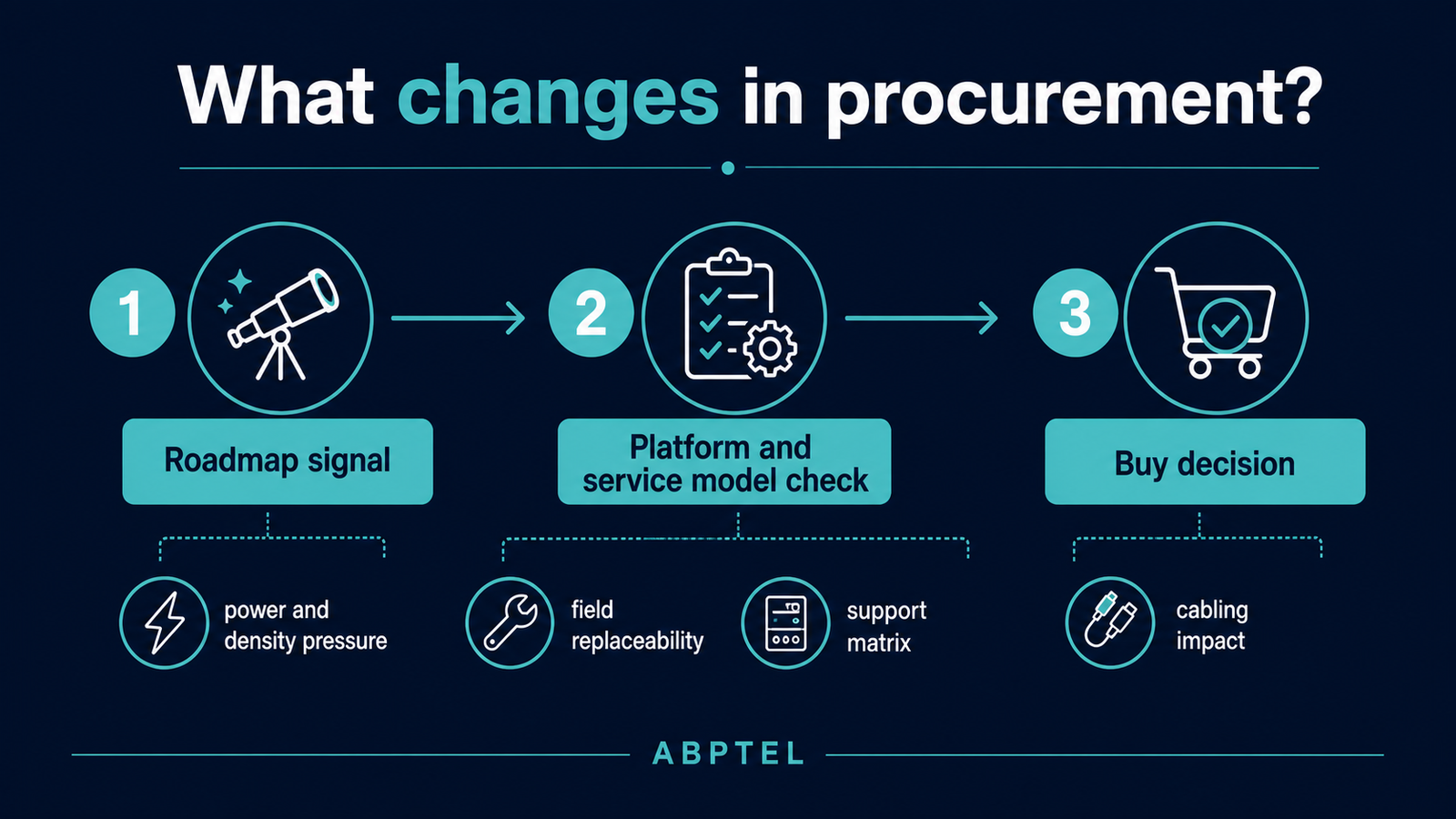
For procurement, CPO is better understood as a migration signal:
- higher-end systems may adopt it first,
- the operational model will change,
- but pluggable optics will still be the practical choice for many deployments where serviceability and vendor flexibility matter more than a small power gain.
What actually changes
1. The replacement model changes
With pluggables, the common repair action is simple:
- pull the module,
- clean the interface,
- replace the optic,
- restore service.
With CPO, the service boundary shifts closer to the host platform.
That means the buyer is no longer only asking, "Which optic do I buy?" The buyer is also asking:
- What is the service procedure?
- What does failure isolation look like?
- What gets replaced in the field?
- What spares do I need?
If the answer is "the platform, not just the module," procurement risk goes up immediately.
2. The buying checklist changes
For pluggables, the purchase checklist usually centers on:
- form factor
- reach
- fiber type
- coding / compatibility
- host support
For CPO, the checklist expands:
- platform family
- service model
- module-to-system boundary
- optical routing inside the platform
- fiber breakout and connector strategy
That is why CPO should be treated as a system decision, not only a parts decision.
3. The cabling conversation changes
Fiber does not disappear.
In fact, the cabling conversation becomes more important because the optical path is now closer to the platform design. Buyers still need to verify:
- connector type
- fiber count
- polarity
- cleaning method
- patching layout
- documentation
If those items are vague, CPO does not simplify the project. It only moves the complexity to a different layer.
What stays the same
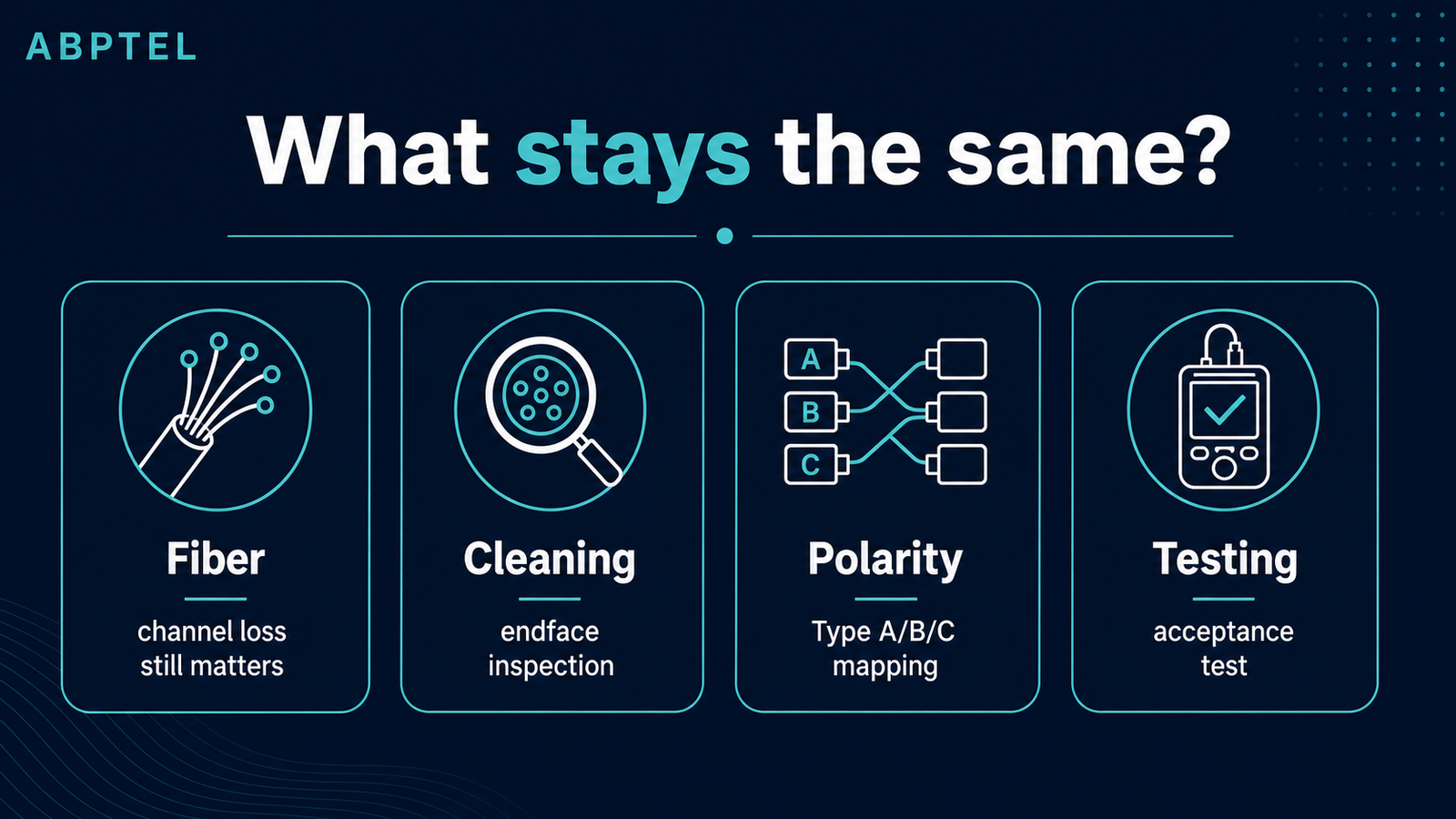
Fiber still matters
The cable plant does not stop mattering just because the optical engine moves.
If anything, tighter integration makes disciplined fiber handling more important:
- the connector path is still real,
- insertion loss still matters,
- endface cleanliness still matters,
- labeling still matters,
- acceptance testing still matters.
High-density cabling still matters
For AI fabrics, the pressure is still on density, routing, and maintainability.
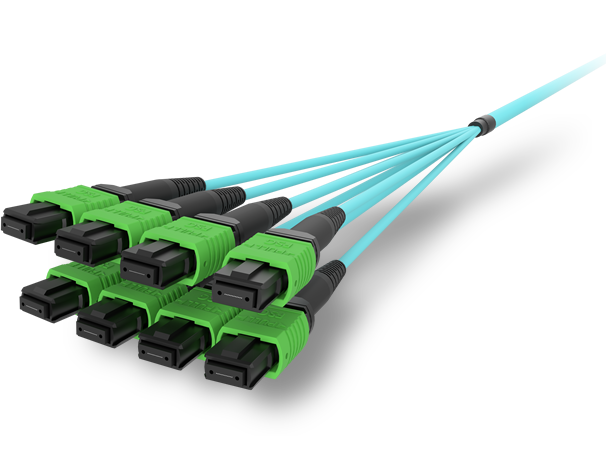
That means MPO/MTP trunks, patch panels, and short-reach interconnects remain part of the picture. The form may evolve, but the operational problem is the same: keep the fabric serviceable under higher port density.
Pluggable optics still matter
For the next few deployment cycles, pluggables remain the best answer when the buyer values:
- field replaceability,
- multi-vendor sourcing,
- predictable spare strategy,
- simpler acceptance testing.
So the procurement conclusion is not "CPO instead of pluggables." It is "CPO where the platform demands it, pluggables where operations still need flexibility."
Procurement migration checklist
Use this before you decide whether a project should stay on pluggables or start planning for CPO-related changes.
1. What problem are you solving?
If the problem is:
- short reach,
- rack density,
- cable management,
- standard data center turnover,
then pluggables are usually still the cleaner fit.
If the problem is:
- extreme power pressure,
- platform density at the top end,
- vendor roadmaps that already assume tighter integration,
then CPO becomes relevant as a planning item.
2. What happens if a link fails?
This is the question many teams skip.
If failure recovery depends on replacing a larger part of the platform, the downtime model changes.
Before you buy, confirm:
- what is field-replaceable,
- what is not,
- what spares are required,
- what the RMA path looks like.
3. What is the host platform support status?
Do not buy against a roadmap headline.
Verify:
- supported platform family,
- validation status,
- intended deployment window,
- firmware / software dependencies,
- approved optical ecosystem.
4. What cabling changes are required?
Ask whether the design needs:
- different connector density,
- different trunking,
- new breakout methods,
- new labeling rules,
- new inspection and cleaning procedures.
If the answer is "we are not sure yet," then the project is not ready for a CPO-led procurement decision.
5. What is the spare strategy?
Pluggables are easy to stock and swap.
CPO may not be.
Before you commit, define:
- spare part levels,
- turnaround expectations,
- who owns the platform-side failure,
- how service windows are scheduled.
6. Is the project actually a near-term deployment?
If the answer is yes, the safest path is usually still pluggable optics with disciplined cabling.
If the answer is no and the project is a longer roadmap program, then CPO deserves a place in the architecture review.
ABPTEL view
For ABPTEL buyers, the practical position is simple:
- keep selling and buying pluggable 400G/800G where the project needs serviceability,
- prepare the fiber plant for higher density,
- watch CPO as a roadmap shift, not as an immediate replacement,
- do not let a headline about the future replace the checklist for the current build.
That is also why we are not turning CPO into a product pitch.
The useful work right now is to help buyers decide what they should verify before they order.
FAQ
Is CPO replacing pluggable optics right now?
No. It is a roadmap direction with real momentum, but pluggables still dominate most near-term deployments.
Does CPO eliminate the need for cabling discipline?
No. Cleaning, polarity, connector choice, and documentation still matter.
Should procurement teams stop buying 800G pluggables because of CPO?
No. For 2026-2028 projects, 800G pluggables are still the practical default in many systems.
What should buyers do instead?
Verify the platform, failure model, fiber plan, and spare strategy before they decide whether a project should stay pluggable or move closer to a CPO-style architecture.
Sources
Official sources used for the current industry direction:
- NVIDIA Spectrum-X Ethernet Platform
- NVIDIA Spectrum-X Validated Solution Stack
- Broadcom: Scaling AI Infrastructure at OFC 2026
- Ethernet Alliance 2026 Ethernet Roadmap
Next step
If your project is still on pluggable optics, the next useful checklist is usually:
- 800G form factor selection,
- cabling polarity,
- reach and fiber type,
- acceptance testing.
If you want the procurement migration checklist in a shorter social format, use the LinkedIn and Facebook drafts that follow this article.
Talk to ABPTEL
Looking for the right optical hardware for your AI data center, GPU cluster, or FTTA project? ABPTEL ships from Shenzhen with OEM/ODM support, fast lead times, and engineering-level pre-sales advice.
- 🔥 400G & 800G OSFP / QSFP-DD Transceivers — for AI training fabrics and hyperscale spine-leaf
- 📡 MPO / MTP High-Density Cabling — 12 / 24 / 32-fiber for high-density data centers
- ⚡ AOC & DAC Cables — short-reach GPU interconnects, OEM compatible
- 🧩 SFP / SFP+ / SFP28 / QSFP28 Modules — 1G to 100G optical transceivers
- 📋 Data Center Cabling Solutions — end-to-end design guide
- ❓ Read our FAQ — compatibility, polarity, lead time, MOQ
💬 Get a quote in 12 hours: Contact Candy · WhatsApp +86 188 1445 5697 · candy@abptel.com