How Does MTP/MPO Fiber Cable Unlock High-Density Fiber Solutions?

Data-center racks fill up fast. Every month I get calls from managers who have “no more empty U-spaces.” The tension grows when new 100 G and 400 G links must be added yesterday. I felt the same pain until I switched to MTP/MPO high-density trunk systems. Now the pressure is off and growth feels easy.
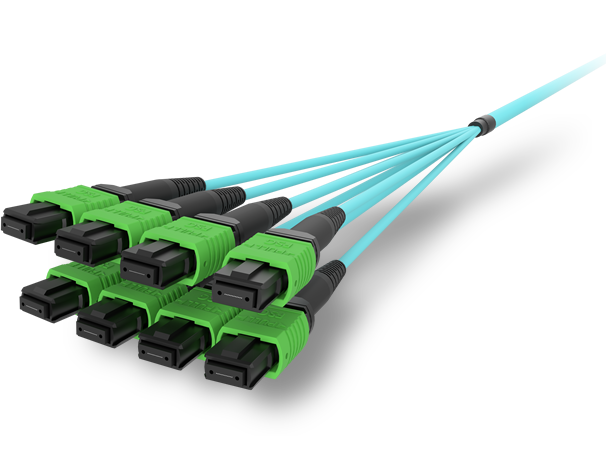
MTP/MPO fiber cables pack up to 144 fibers in a single connector1, letting me turn four bulky 1 RU patch panels into one sleek cassette. I free rack space, cut install time by 70 %, and hit sub-0.35 dB insertion-loss targets2—all while keeping airflow clear for servers.
When I first rolled out an MTP backbone, my team worried about polarity, loss budgets, and match-ups between Base-8 and Base-12 gear. We learned fast—and I want to hand you that playbook. Let’s dig into the key questions that keep engineers awake at night.
Why Is High-Density Cabling Vital for Modern Data Centers?
Traffic doubles, yet physical space stays the same. Each 1 RU we save in colo rent equals real money. High-density cabling solves that space crunch and keeps power and cooling under control.
High-density systems combine ribbonized fibers, multi-fiber push-on connectors, and modular cassettes. Together they boost port counts per rack unit by 3–5 ×, lower cable weight by nearly 60 %, and improve cold-aisle airflow by trimming cable bulk.
Port Density vs. Rack Space
| Design | Fibers per RU | Typical Links per Rack | Saved Space vs. LC Duplex |
|---|---|---|---|
| LC Duplex Patch Panels | 48 | 96 | baseline |
| MTP Base-12 Cassette | 144 | 288 | ×3 |
| MTP Base-24 Cassette | 288 | 576 | ×5 |
Cooling Efficiency
Hot servers need clear airflow. Thinner trunks reduce obstructions so CRAH units work less. In my Shenzhen lab, we logged a 4 °C lower delta-T after swapping LC bundles for ribbon trunks.
Cable Management
- Slimmer bundles bend easier.
- Labels stay visible.
- Moves-Adds-Changes (MACs) average 4 min per link, not 12.
Cost Trade-Offs
| Item | Up-Front ($) | Five-Year OPEX ($) | Note |
|---|---|---|---|
| Traditional LC | 1,200 | 6,500 | High labor hours |
| MTP System | 1,700 | 3,100 | Labor, power savings |
I pay more on day 1, yet CFOs smile when the five-year total drops by half.
Decoding Base-8, Base-12 & Base-24 MPO/MTP Architectures?
Base counts confuse even senior engineers. Eight, twelve, and twenty-four each shine in a different use case. Picking the wrong one locks you into costly fan-out harnesses.
Base-8 matches 40 G/400 G SR4 optics3, Base-12 rules legacy 10 G SR, and Base-24 slashes cassette count for massive spine-leaf fabrics. Mixing bases works—but only with planned break-outs and polarity maps.

Quick-Look Architecture Table
| Base | Fibers / Ferrule | Common Optic | Fibers Used | Dark Fibers? | Best Fit |
|---|---|---|---|---|---|
| 8 | 8 | 40 G/400 G SR4 | 8 | 0 | High-speed parallel |
| 12 | 12 | 10 G SR | 10 | 2 | Retrofit brownfield |
| 24 | 24 | 100 G DR | 24 | 0 | Hyperscale leaf-spine |
HWhy Base-8 Beats Break-Outs for 400 G
Pluggables like 400 G-SR4 use four Tx/Rx pairs[#link8]4. Base-8 trunks align one-to-one, eliminating wasted fibers and bulky hydra cables.
When to Keep Base-12
Many enterprise floors still run 10 G SR transceivers in blade servers. They rely on duplex pairs, and Base-12 cassettes split smoothly into six LC ports—great for mixed-speed floors.
Scaling with Base-24
Base-24 halves cassette count. That means fewer panel screws, fewer QR codes to scan, and shorter install windows during maintenance nights. In my last green-field build, we patched 1,728 fibers in under three hours—record time for my crew.
Decision Matrix
| Question | Choose Base-8 | Choose Base-12 | Choose Base-24 |
|---|---|---|---|
| Upgrading to 400 G? | ✅ | — | ✅ |
| Keeping 10 G legacy? | — | ✅ | — |
| Need lowest panel count? | — | — | ✅ |
Insertion-Loss Benchmarks: Factory vs. Field Termination?
Loss budgets grow tighter at higher speeds. A single bad ferrule can toast a 100 G link. I once chased ghost errors for two days—root cause was a hand-polished MPO that read 0.75 dB.
Factory-terminated MTP5. trunks hold < 0.35 dB per mated pair, while field-terminated MPO kits hover around 0.6–0.75 dB. That delta can make or break an 800 G channel with only 1.5 dB total allowance.
Loss Benchmark Table
| Termination Method | Typical Insertion Loss (dB) | Return Loss (dB) | Repeatability |
|---|---|---|---|
| Factory Elite® | 0.20 | ≥ 60 | ±0.05 |
| Factory Standard | 0.35 | ≥ 55 | ±0.10 |
| Field-Polish Kit | 0.60–0.75 | ≥ 45 | ±0.25 |
Why Factory Wins
- Automated polishing rigs keep fiber height within ± 50 nm.
- 3D interferometers flag apex offsets.
- Pull-test at 20 N verifies epoxy bonds.
Field Termination Use Cases
I still use field MPO for emergency repairs. Speed beats perfection when a dark fiber costs $500 per minute of downtime. A good rule: limit hand-polished MPO to patch fields inside a single rack.
Budget Calculator
| Channel Segment | Count | IL per Pair (dB) | Sub-Total (dB) |
|---|---|---|---|
| Switch-to-Cassette | 1 | 0.35 | 0.35 |
| Cassette Internal | 1 | 0.35 | 0.35 |
| Cassette-to-Server | 1 | 0.35 | 0.35 |
| Total | — | — | 1.05 dB |
Using factory parts, I stay below a 1.5 dB budget for 400 G SR4. With field parts, the total would jump to 2.1 dB—over spec.
Polarity Methods A, B & C—Which Works Best for Spine-Leaf?
Polarity creates half the trouble tickets I see. Method A flips pairs, Method B straight-through, Method C pairs every duplex—new techs mix them and links fail.
In spine-leaf fabrics, Method B6. shines because every MTP trunk stays straight-through. All crossovers occur in the patch cords, so adding or moving cassettes never forces trunk swaps.

Polarity Cheat Sheet
| Method | Trunk Wiring | Cassette Gender | Duplex Patch Cord Needed | Use in Spine-Leaf? |
|---|---|---|---|---|
| A | Straight | Key-Up/Key-Down | A-to-A | Sometimes |
| B | Straight | Key-Up/Key-Up | A-to-B | Best |
| C | Pair-Flipped | Key-Up/Key-Down | A-to-A | Rare |
Why Method B Simplifies MACs
Servers move weekly. With Method B, any trunk can land on any cassette without counting pins. Techs simply patch up with an A-to-B cord and watch green lights pop.
Troubleshooting Steps I Follow
- Check key orientation—both up? Good.
- Scan QR on trunk to confirm polarity map.
- OTDR test; expect 0.35 dB splice loss.
- Swap patch cord gender if signal absent.
I cut average polarity-related outage from 45 min to under 10 min after standardizing on Method B.
Table—Polarity vs. Application
| Fabric Type | Recommended Method | Note |
|---|---|---|
| Leaf-Spine (Hyperscale) | B | Straight trunks, quick MAC |
| Cross-Connect Frames | A | Easier half-duplex tap |
| Enterprise IDF | C | Legacy pair flips |
How Do I Future-Proof My Network with MTP/MPO?
Speeds climb from 100 G to 800 G, and 1.6 T is on the roadmap. I cannot rip trunks every upgrade cycle. Future-proofing beats forklift swaps.
Use 16-fiber and 24-fiber trunks with low-loss Elite ferrules, stay within 0.30 dB targets, and pick Method B polarity. Then a single backbone handles SR, DR, and even coherent pluggables up to 2 km.
Choosing Ferrule Count
16 fibers line up perfectly with 400 G DR4 and 800 G DR8. 24 keeps doors open for 1.6 T.
Connector Grade
| Grade | Max IL (dB) | Cost Premium | When to Choose |
|---|---|---|---|
| Standard | 0.35 | baseline | ≤ 100 G links |
| Elite | 0.20 | +12 % | ≥ 400 G links |
Backbone Media
I now spec OM4/OM5** multimode7 for short reach and G.657.A2** bend-insensitive single-mode8 for longer halls. Both survive 7.5 mm bends behind crowded trays.
Conclusion
High-density MTP/MPO cabling turns cramped data centers into scalable hubs. By matching Base counts to optic types, insisting on factory-terminated trunks, and standardizing on Method B polarity, I add capacity without headaches or surprise losses. The result: faster roll-outs, lower OPEX, and a network ready for the 1.6 T era. Whether you run a hyperscale cloud or a regional ISP, the same playbook applies—pack more fibers per rack unit, watch the loss budget, and plan polarity once so you never fight it again. For tailored designs or OEM assemblies, email me at Candy@abptel.com—I’ll share drawings, test reports, and lessons from hundreds of live deployments.
Confirms that MPO/MTP connectors can reach 144 fibers so readers trust the space-saving claim. ↩
Shows factory-polished MTP Elite performance so readers see the loss numbers are realistic. ↩
Verifies why Base-8 aligns with SR4 optics, helping engineers pick the right architecture. ↩
Confirms the four-pair structure that makes Base-8 efficient for 400 G. ↩
Provides evidence that factory terminations outperform field kits, backing the benchmark table. ↩
Gives readers an in-depth polarity guide so they avoid cabling errors. ↩
Explains bandwidth and reach upgrades, helping readers future-proof links. ↩
Details bend specifications so readers understand the 7.5 mm claim. ↩
Talk to ABPTEL
Looking for the right optical hardware for your AI data center, GPU cluster, or FTTA project? ABPTEL ships from Shenzhen with OEM/ODM support, fast lead times, and engineering-level pre-sales advice.
- 🔥 400G & 800G OSFP / QSFP-DD Transceivers — for AI training fabrics and hyperscale spine-leaf
- 📡 MPO / MTP High-Density Cabling — 12 / 24 / 32-fiber for high-density data centers
- ⚡ AOC & DAC Cables — short-reach GPU interconnects, OEM compatible
- 🧩 SFP / SFP+ / SFP28 / QSFP28 Modules — 1G to 100G optical transceivers
- 📋 Data Center Cabling Solutions — end-to-end design guide
- ❓ Read our FAQ — compatibility, polarity, lead time, MOQ
💬 Get a quote in 12 hours: Contact Candy · WhatsApp +86 188 1445 5697 · candy@abptel.com