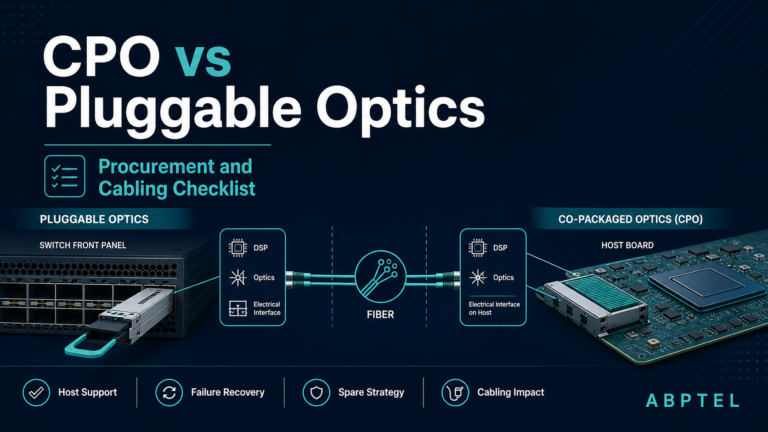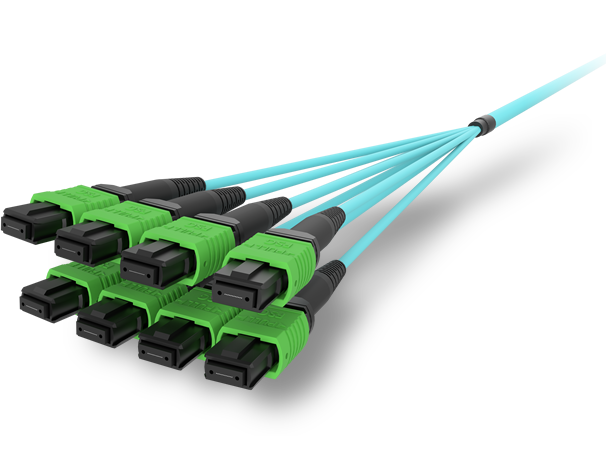
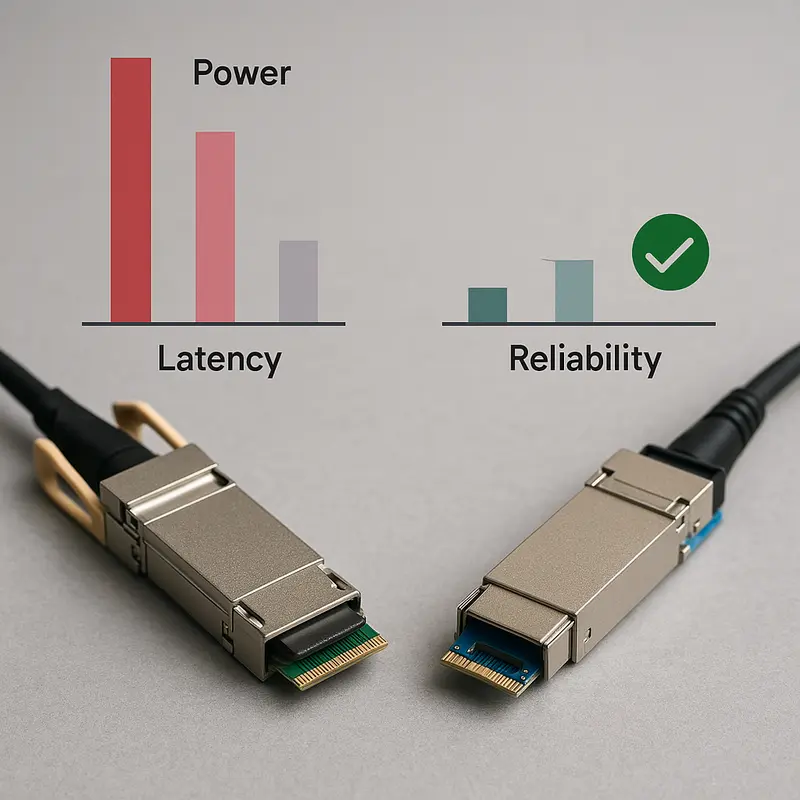
The Cisco Nexus 9000 series is one of the most widely deployed data center switching platforms — and the 800G generation is showing up in production AI fabrics throughout 2026. If you are sourcing 800G transceivers and the matching MPO cabling for a Cisco Nexus deployment, the compatibility matrix matters as much as the optics themselves. This guide walks through which Nexus models accept which 800G transceivers, what MPO trunks to spec, and the procurement checklist that prevents the most common compatibility issue we see.
⚡ TL;DR — Cisco Nexus 800G cabling rules
- Nexus 9332D-H2R / 9364D-GX2A (Tomahawk 5 class): native 800G QSFP-DD800 ports — use MPO-16 trunks for 800G-DR8 / SR8 optics.
- For 800G-2×FR4 / 2×DR4 breakout to 2× 400G ports: use 2× MPO-12 trunks per 800G port.
- Polarity: Type B trunks for all parallel-fiber Cisco 800G optics. Cisco IOS XE and NX-OS expect Type B mapping by default.
- Firmware: Compatible third-party 800G transceivers must be programmed with Cisco-specific EEPROM data. Always confirm the optic ships with “Cisco compatible” firmware coding.
Cisco Nexus 800G platforms in 2026
The Cisco Nexus 9000 800G generation is built on the Broadcom Tomahawk 5 ASIC (51.2 Tbps switching capacity) and supports QSFP-DD800 (also called QSFP-DD 2.0) optics. The most commonly deployed models for AI data center fabrics:
- Nexus 9332D-H2R — 32× 800G QSFP-DD ports in 1RU. Designed for AI training spine and high-density spine-leaf.
- Nexus 9364D-GX2A — 64× 400G QSFP-DD ports (also 800G capable via QSFP-DD800). Common as leaf-to-spine aggregator.
- Nexus 9408 / 9416 modular — modular chassis with 800G line cards for large-scale deployments.
All of these platforms accept native QSFP-DD800 optics. They are backward compatible with 400G QSFP-DD optics, so you can mix 800G and 400G in the same chassis when migration is gradual.
Compatible 800G optics and matching MPO cabling
| Cisco 800G optic | Form factor | Reach | Required cabling |
|---|---|---|---|
| 800G-DR8 | QSFP-DD800 | 500 m SMF | MPO-16 trunk (OS2) |
| 800G-SR8 | QSFP-DD800 | 50 m MMF OM4 | MPO-16 trunk (OM4) |
| 800G-VR8 | QSFP-DD800 | 30 m MMF OM4 | MPO-16 trunk (OM4) |
| 800G-2×DR4 | QSFP-DD800 | 500 m SMF | 2× MPO-12 trunk (OS2) |
| 800G-2×FR4 | QSFP-DD800 | 2 km SMF | 2× Duplex LC (OS2) |
| 800G-2×SR4 | QSFP-DD800 | 100 m MMF | 2× MPO-12 trunk (OM4) |
| 800G-LR4 / FR8 | QSFP-DD800 | 10 km / 2 km | Duplex LC (OS2) |
Polarity: why Type B is the default for Cisco
Cisco’s reference designs assume Type B polarity for all parallel-fiber 800G optics. This applies to DR8, SR8, VR8, and the 2×DR4 / 2×SR4 breakout variants. The reason: Type B handles the TX/RX cross inside the trunk, removing the need for cassette-based crossover and keeping the cabling architecture simple.
If you are migrating from older Cisco 100G or 40G deployments that use Type A trunks with crossover cassettes, plan a refresh to Type B during your 800G upgrade. This is the right time to standardize.
Firmware coding: the compatibility issue most teams miss
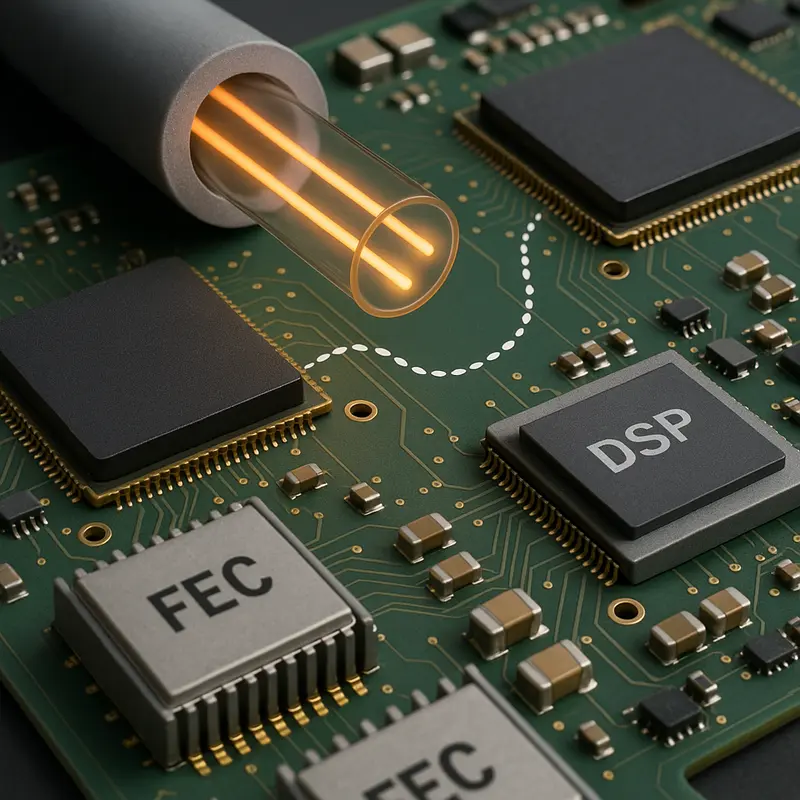
Cisco transceivers carry vendor-specific EEPROM data that the switch firmware reads at insertion. If the data does not match what the NX-OS expects, the switch logs a warning (“non-supported transceiver”) and may refuse to enable the port.
For genuine Cisco-branded optics, this is a non-issue. For third-party Cisco-compatible 800G optics — which often offer significant cost savings over Cisco-branded — the supplier must program the EEPROM with the correct Cisco compatibility data. When sourcing third-party 800G optics for Cisco Nexus:
- Confirm the supplier explicitly supports the target Cisco platform (Nexus 9332D-H2R, 9364D-GX2A, etc.)
- Request the supplier’s compatibility statement for your specific switch model and NX-OS version
- Order a 2-3 unit eval batch and test in a live switch port before committing to a bulk order
- Have the supplier confirm support for the “service unsupported-transceiver” override if your IT policy requires it as a fallback
“We coded Cisco compatibility into every 800G transceiver we ship for Nexus deployments. Customers test a 2-unit sample first; we have not had a firmware compatibility issue in over 6,000 shipped units across the 800G generation.”
— ABPTEL Engineering Team
A 5-step procurement checklist for Cisco Nexus 800G
- Confirm switch model and NX-OS version. Different Nexus platforms have different optic compatibility lists. Pull this from your switch CLI:
show versionandshow inventory. - Choose the optic SKU based on reach and breakout strategy. Native 800G (DR8 / SR8) for short runs; 2×DR4 / 2×FR4 for breakout to 400G; FR8 / LR8 for long-reach spine.
- Match cabling to optic. MPO-16 for DR8 / SR8 / VR8; 2× MPO-12 for 2×DR4 / 2×SR4; Duplex LC for FR4 / FR8 / LR8.
- Specify Type B polarity on all MPO trunks. Cisco reference designs assume this.
- Order an eval batch first. 2-3 transceivers, tested in a live switch port, validates firmware coding before bulk commitment.
⚠️ Common Cisco Nexus 800G mistake
Teams order 800G-2×DR4 transceivers (because that is the cheapest 800G SMF option) without realizing that each optic needs 2× MPO-12 trunks connected, not one. The cabling SKU count doubles. Plan the trunk inventory accordingly, or you will be short by week 2 of deployment.
Frequently asked questions
Are third-party 800G optics safe for Cisco Nexus production deployments?
Yes, when sourced from a supplier with established Cisco-compatibility programming. Third-party 800G QSFP-DD optics from reputable suppliers typically deliver identical optical performance to Cisco-branded at 40-60% lower cost. The risk is supplier-side: bad firmware coding, inconsistent quality control, or undocumented compatibility gaps. Always do eval testing.
Can I mix 400G and 800G optics in a single Nexus 9332D-H2R?
Yes. QSFP-DD800 ports are backward compatible with 400G QSFP-DD optics. Use this for gradual migration: start with 400G in unused ports, replace with 800G as your fabric demand grows.
Does Cisco NX-OS need a configuration command to accept third-party transceivers?
If the transceiver is properly programmed with Cisco-compatible EEPROM, no command is required — the switch accepts it as if it were genuine Cisco. The service unsupported-transceiver command exists as a safety override but should not be needed with quality third-party optics.
What is ABPTEL’s lead time for Cisco-compatible 800G optics?
We hold stock on the most-requested Cisco Nexus compatible 800G optics: DR8, FR4, 2×DR4, 2×FR4, and 2×SR4. Stock SKUs ship in 3-5 business days. Bulk projects (50+ units) ship in 2-3 weeks with project-specific firmware coding if needed.
Does ABPTEL stock the matching MPO trunks for Cisco 800G fabric?
Yes. We supply MPO-12 and MPO-16 Type B trunks in OS2 and OM4 fiber in lengths from 1 m to 100 m. Custom lengths and polarities for project deployments ship in 2-3 weeks.
Source Cisco Nexus 800G optics and cabling from ABPTEL
- 🔥 800G QSFP-DD & OSFP transceivers — Cisco-compatible firmware coded
- 📡 MPO-12 & MPO-16 trunks — Type B polarity in stock
- 📖 MPO-12 vs MPO-16 for 800G guide — which connector for your fabric
- 📖 400G vs 800G for AI clusters — decision framework
- 📋 Data Center cabling design — end-to-end project support
💬 Request a Cisco Nexus 800G compatibility quote: Contact us · WhatsApp +86 188 1445 5697 · candy@abptel.com — typical response in 12 hours, eval samples ship in 48.
Talk to ABPTEL
Looking for the right optical hardware for your AI data center, GPU cluster, or FTTA project? ABPTEL ships from Shenzhen with OEM/ODM support, fast lead times, and engineering-level pre-sales advice.
- 🔥 400G & 800G OSFP / QSFP-DD Transceivers — for AI training fabrics and hyperscale spine-leaf
- 📡 MPO / MTP High-Density Cabling — 12 / 24 / 32-fiber for high-density data centers
- ⚡ AOC & DAC Cables — short-reach GPU interconnects, OEM compatible
- 🧩 SFP / SFP+ / SFP28 / QSFP28 Modules — 1G to 100G optical transceivers
- 📋 Data Center Cabling Solutions — end-to-end design guide
- ❓ Read our FAQ — compatibility, polarity, lead time, MOQ
💬 Get a quote in 12 hours: Contact Candy · WhatsApp +86 188 1445 5697 · candy@abptel.com