If you’ve ever installed an MPO/MTP trunk only to find that the signal does not pass end-to-end, you’ve met the polarity problem. Polarity in fiber cabling means making sure the transmit fiber at one end lands on the receive port at the other — and in a multi-fiber MPO cable, that mapping is not automatic. This guide walks through the three polarity standards (Type A, Type B, Type C) defined in TIA-568, explains when to use each, and gives you a procurement checklist so you order the right SKU the first time.
⚡ TL;DR — Which polarity to use?
- Type B — Use for modern data centers running parallel optics (40G SR4, 100G SR4, 100G PSM4, 400G DR4, 400G SR4.2, 800G DR8). This is the de-facto standard for new builds in 2026.
- Type A — Use for legacy duplex applications and some specific 40G/100G installations using MPO-LC breakout patterns with crossed pairs at the patch panel.
- Type C — Mostly obsolete. Used historically for duplex-over-MPO. Avoid in new installations unless you are matching existing Type C infrastructure.
- If unsure — Pick Type B. It works for every modern parallel-optic transceiver and is what 90% of new data center MPO trunks ship as.
What is polarity in MPO/MTP cabling?
In a duplex LC fiber pair, polarity is obvious — you have two distinct connectors, one for TX, one for RX. In a 12-fiber MPO connector, all 12 fibers are arranged in a single horizontal row, and the cable has to route each fiber from one end to a specific position at the other end. The way those positions are mapped is what we call polarity.
TIA-568 defines three polarity methods: Type A, Type B, and Type C. They differ in how fiber positions 1 through 12 map across the trunk and at the patch panel, and in how the connector gender (key-up vs key-down) is oriented at each end.
Type A polarity (straight-through)
Mapping: Fiber position 1 → 1, 2 → 2, …, 12 → 12 (one-to-one straight through).
Connector orientation: Key-up to key-down (one end key faces up, the other key faces down — the cable has to physically flip).
How TX/RX cross occurs: The cross happens at the duplex LC breakout end. One end of the patch cord uses an "A-to-B" cassette, the other uses an "A-to-A" cassette.
Best for: Legacy 10G duplex links and certain 40G/100G environments where the patch panel handles the cross. Type A is also commonly used in some carrier and FTTH applications.
Type B polarity (reversed pairs)
Mapping: Fiber 1 ↔ 12, 2 ↔ 11, 3 ↔ 10, …, 12 ↔ 1. The order is fully reversed inside the trunk.
Connector orientation: Key-up to key-up (both ends have the key facing the same direction).
Why this matters: Modern parallel-optic transceivers — 40GBASE-SR4, 100G-SR4, 100G-PSM4, 400G-DR4, 400G-SR4.2, 800G-DR8 — expect a TX fiber on one side to land on the RX fiber at the matching position on the other side. Type B handles this natively without any patch-panel cross-over.
Best for: Modern data center fabrics running parallel optics. This is the dominant choice in 2026 new builds and is what we ship 90% of the time for our customers.
Type C polarity (per-pair crossover)
Mapping: Fibers cross in pairs — 1 ↔ 2, 3 ↔ 4, 5 ↔ 6, …, 11 ↔ 12.
Connector orientation: Key-up to key-down (same as Type A).
Best for: Duplex-over-MPO links where each fiber pair acts as a single TX/RX duplex. Type C was popular in early 10G/40G transitional deployments but has largely been replaced by Type B for parallel applications and by Type A with cassettes for duplex applications.
Side-by-side comparison
| Property | Type A | Type B | Type C |
|---|---|---|---|
| Fiber mapping | Straight (1→1, 12→12) | Reversed (1↔12) | Pair cross (1↔2, 3↔4…) |
| Connector orientation | Key-up to Key-down | Key-up to Key-up | Key-up to Key-down |
| TX/RX cross handled at | Patch panel cassette | Inside the trunk | Inside the trunk (pairs) |
| Best application | Duplex with cassettes | Parallel optics (modern DC) | Legacy duplex-over-MPO |
| Common today (2026) | Some legacy DC, FTTH | ✅ Dominant standard | Mostly retired |
| Works with 400G DR4 / 800G DR8 | Requires special breakout | ✅ Native fit | ❌ Not recommended |
A decision tree: which polarity should you order?
- Is this an MPO-to-MPO trunk for parallel transceivers (SR4, DR4, SR8, DR8)?
→ Type B. Done. - Is this an MPO-LC breakout for duplex links (10G/25G LC transceivers)?
→ Type A trunk + Type A cassettes (with one end being A-to-B cassette). This is the most common LC breakout topology. - Are you matching existing infrastructure?
→ Order the same polarity that is already installed. Mixing polarities causes signal loss and is the #1 source of MPO troubleshooting tickets we see. - Are you migrating from 10G/40G to 100G/400G?
→ Audit existing polarity first. Many “Type A” legacy installations need re-jacketing or cassette swaps to support parallel optics. We can advise during the design phase.
⚠️ Three procurement traps we see weekly
- Ordering “Type A” when you mean “Type B.” Some vendors use legacy labeling and call modern parallel-ready trunks “Type A reversed.” Always confirm the fiber mapping diagram with the supplier — do not rely on the polarity letter alone.
- Mixing polarities in a single fiber path. If your trunk is Type B and your patch cord is Type A, you will get a TX/RX mismatch at the receiver. Standardize per link.
- Forgetting the connector gender (male/female pins). Polarity is independent of connector gender. A Type B trunk can have male-male, female-female, or male-female pin configurations. Match the gender to the device port type, separately from the polarity decision.
Frequently asked questions
Can I use Type A and Type B in the same data center?
Yes, but standardize per fiber path. A single trunk-to-trunk link must use one polarity end-to-end. Many data centers run Type B for parallel-optic fabric and Type A with cassettes for duplex breakout — that is fine as long as each link is internally consistent.
Does polarity matter for MPO-24 or MPO-32?
The TIA-568 polarity definitions formally cover 12-fiber MPO. For 24-fiber MPO, most manufacturers extend Type B logic — fiber 1 maps to fiber 24, fiber 2 to fiber 23, and so on. For 16-fiber MPO (used in 800G DR8), TIA-568.2-E adds a specific Type B-equivalent definition. Always request the manufacturer’s polarity diagram for any non-12-fiber MPO.
How do I test the polarity of an existing trunk?
Use a visual fault locator (VFL) at one end and check which fiber lights up at the other end. Walk through positions 1, 6, and 12 — that is enough to identify Type A (straight), Type B (reversed), or Type C (pair-crossed). For production troubleshooting, an MPO-aware OTDR will give you a full per-fiber map.
Does ABPTEL stock all three polarity types?
Yes, we hold stock on Type B in the most common lengths (1m, 3m, 5m, 10m) and offer Type A and Type C as build-to-order. For project quantities (≥ 50 trunks), we can ship custom polarities, lengths, and connector configurations within 2-3 weeks.
What is the difference between MTP and MPO?
MTP® is US Conec’s branded high-performance variant of the MPO connector. MTP and MPO are mechanically compatible — you can mate an MTP to an MPO. MTP connectors have tighter tolerance pins, better field repairability, and lower insertion loss. For premium data center deployments, we recommend genuine MTP. For cost-sensitive bulk projects, standard MPO is acceptable.
Source MPO/MTP cabling from ABPTEL
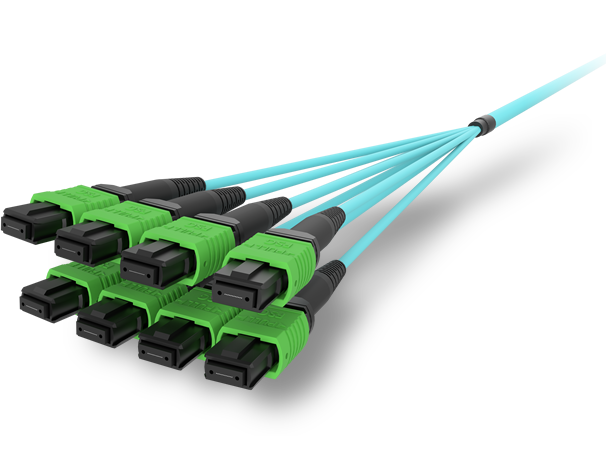
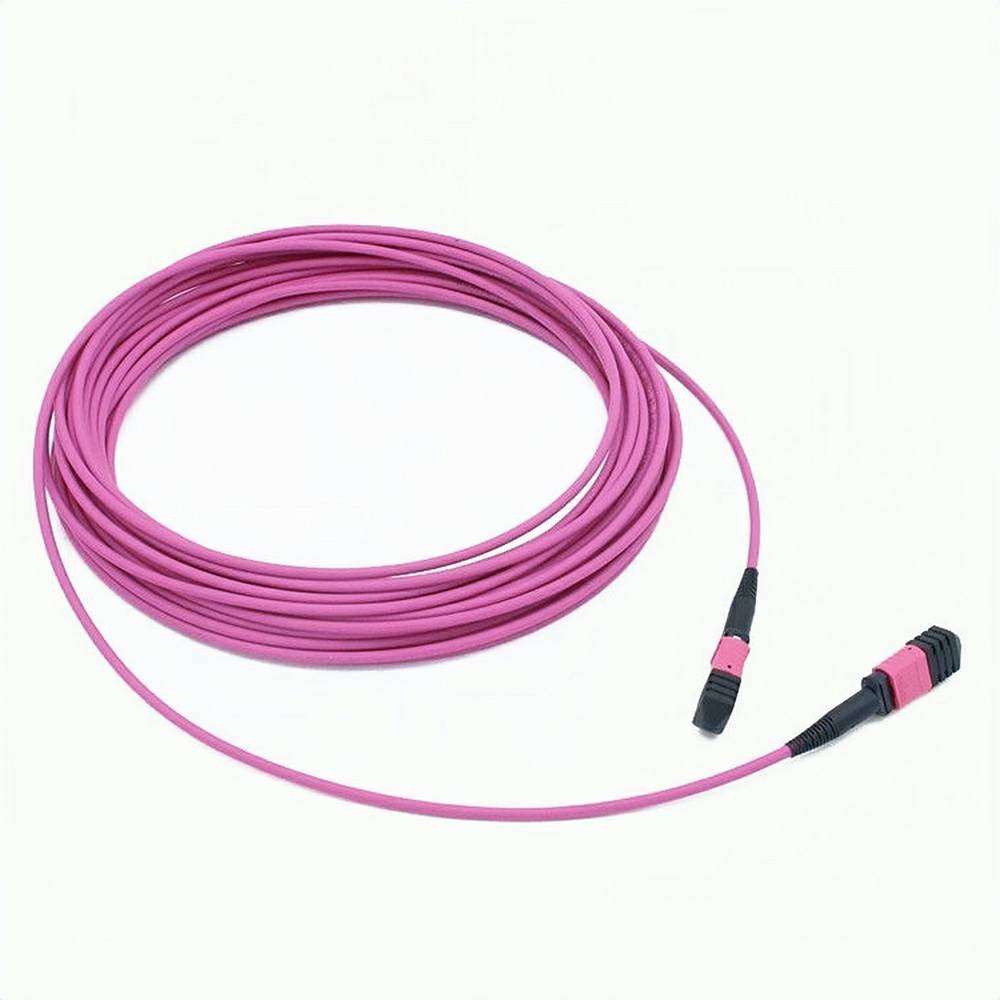
ABPTEL stocks MPO-12, MPO-16, MPO-24, and MPO-32 trunks, jumpers, breakouts, and cassettes in all three TIA polarity standards. Every cable ships with the polarity diagram in the documentation pack and is 3D interferometer tested for end-face quality.
- 📡 Browse MPO/MTP cables — trunks, jumpers, breakouts, cassettes
- 🔥 MTP/MPO trunks — 12, 24, 32-fiber pre-terminated
- ⚡ MPO-LC breakouts — Type A and Type B with cassettes
- 🧩 MTP/MPO cassettes — A-to-A and A-to-B configurations
💬 Need help spec’ing polarity for your project? Contact us · WhatsApp +86 188 1445 5697 · candy@abptel.com — typical response within 12 hours.
Talk to ABPTEL
Looking for the right optical hardware for your AI data center, GPU cluster, or FTTA project? ABPTEL ships from Shenzhen with OEM/ODM support, fast lead times, and engineering-level pre-sales advice.
- 🔥 400G & 800G OSFP / QSFP-DD Transceivers — for AI training fabrics and hyperscale spine-leaf
- 📡 MPO / MTP High-Density Cabling — 12 / 24 / 32-fiber for high-density data centers
- ⚡ AOC & DAC Cables — short-reach GPU interconnects, OEM compatible
- 🧩 SFP / SFP+ / SFP28 / QSFP28 Modules — 1G to 100G optical transceivers
- 📋 Data Center Cabling Solutions — end-to-end design guide
- ❓ Read our FAQ — compatibility, polarity, lead time, MOQ
💬 Get a quote in 12 hours: Contact Candy · WhatsApp +86 188 1445 5697 · candy@abptel.com