OPGW Cable Selection Guide: Why “Off-the-Shelf” Specs Fail on Transmission Lines
For power design institutes & EPC managers · By Candy @ ABPTEL
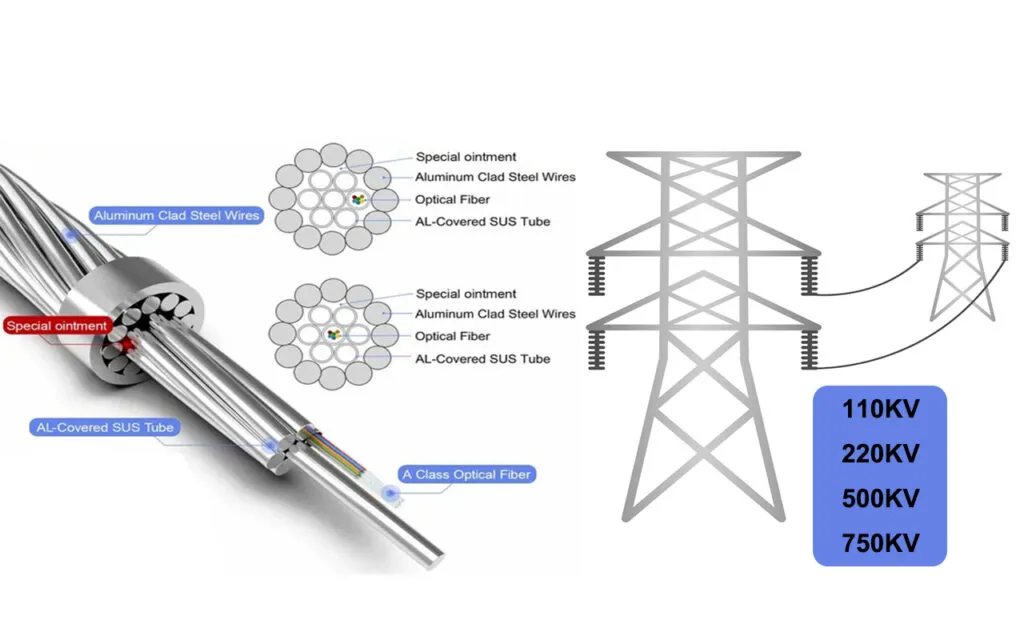
Unlike standard fiber cables, OPGW (Optical Ground Wire) is not a commodity. It is a shield wire that must survive two enemies at the same time: Mechanical Stress (ice/wind) and Electrical Heat (short-circuit & lightning).
We often receive RFQs asking for a “standard 24-core OPGW price.”
Our answer is always: “Please share your tower and short-circuit data first.”
Choosing the wrong structure—like using a heavy stranded OPGW on an old 110 kV tower—can exceed the tower’s wind/ice allowance.
Ignoring the kA²·s requirement can push the fiber coating above 200 °C during faults, melting fibers.
Below is ABPTEL’s engineer guide to match the right OPGW to your grid—you must calculate, not guess.
Quick Structure Selection (At a Glance)
| Scenario | Recommended OPGW | Key Reason | Typical Fiber Count | Notes |
|---|---|---|---|---|
| Retrofit on old lines (110–220 kV), tight tower load | Central Stainless-Steel Tube OPGW | Smaller diameter & weight → lower wind/ice load | 24–48F | Matches original sag-tension; easier construction |
| New main corridors (220–500 kV), high capacity | Multi-Tube Stranded OPGW (Double-Layer Armor) | More tubes → high fiber count & higher RTS | 96–144F | Better heat dissipation for long spans |
| High thunder density / high short-circuit energy | High Short-Circuit OPGW (Lightning-Resistant) | Aluminum-alloy outer wires ↑ conductivity → less thermal rise | 24–72F | Designed by kA²·s verification (1–3 s faults) |
Scenario 1: Retrofitting Old Lines (The Weight Problem)
When upgrading an existing line (replacing galvanized earth wire with OPGW), the #1 constraint is Tower Load.
Old towers were not designed for heavy stranded OPGW. Extra wind/ice load can exceed safety margins and change sag-tension behavior.
Choose the Central Stainless-Steel Tube OPGW.
- Smaller Diameter → lower wind pressure coefficients.
- Lighter → closer to original earth-wire RTS & sag.
- 24–48F → enough for substation/tele-protection rings.
Scenario 2: New UHV Corridors (The Capacity Problem)
On new 220–500 kV corridors, priorities shift to fiber count, heat capacity and RTS. Central tubes cap out in fiber volume.
✅ Solution: Stranded OPGW
Use Multi-Tube Stranded OPGW (double-layer armor). Stranding multiple stainless-steel tubes delivers 96–144F with robust tensile performance for long spans and heavy icing zones.
Scenario 3: Lightning Zones (The Heat Problem)
The most overlooked parameter is Short-Circuit Energy, often expressed as kA²·s.
When a fault or lightning occurs, OPGW conducts current to ground. Instant Joule heating can raise temperature above 200 °C, degrading fiber coating if conductivity is insufficient.
✅ Solution: High Short-Circuit OPGW with Aluminum-Alloy (AA) outer wires. AA offers ~3× the conductivity of steel, dispersing heat faster and protecting fibers during 1–3 s faults.
Thermal Check: The One Number You Must Verify
Utilities typically provide fault current and clearing time (e.g., 32 kA for 1 s). Your OPGW must pass the specified I²·t (kA²·s) without exceeding the allowable temperature rise. Ask for a short-circuit verification sheet during design review.
Don’t Guess Your Specs. Calculate Them.
To issue a valid quote and thermal check, our engineers need:
- Voltage level (kV) & corridor type (new / retrofit)
- Short-circuit current & clearing time (e.g., 31.5 kA · 1 s → 992 kA²·s)
- Required RTS (kN), span length, wind/ice region
- Existing earth-wire data (for retrofit): diameter, mass, sag-tension curve
- Fiber count & routing plan (24F / 48F / 96F / 144F)
We will return a structure proposal (Central Tube / Stranded / High Short-Circuit), thermal verification, and a bill of materials.
Request OPGW Design Sheet →Common Pitfalls We See on OPGW Projects
- Ordering “standard 24F” without kA²·s data → fibers damaged after first thunder season
- Picking stranded OPGW for a fragile retrofit tower → wind/ice overload risk
- Ignoring RTS vs. span / ice region → excessive sag or construction failure
- No thermal verification sheet in the submittal package → approval delays
Explore OPGW Options
• Retrofit / light load → Central Tube OPGW
• High capacity corridors → Stranded OPGW
• Lightning / high fault energy → High Short-Circuit OPGW
• More resources → OPGW Category
OPGW FAQs (Engineers’ Edition)
How do I compare Central Tube vs. Stranded?
Stranded = multi-tube high capacity (96–144F) with higher RTS → better for new long-span corridors.
What is kA²·s and why does it matter?
What data do you need for a formal design?
Can ADSS replace OPGW?
Talk to ABPTEL
Looking for the right optical hardware for your AI data center, GPU cluster, or FTTA project? ABPTEL ships from Shenzhen with OEM/ODM support, fast lead times, and engineering-level pre-sales advice.
- 🔥 400G & 800G OSFP / QSFP-DD Transceivers — for AI training fabrics and hyperscale spine-leaf
- 📡 MPO / MTP High-Density Cabling — 12 / 24 / 32-fiber for high-density data centers
- ⚡ AOC & DAC Cables — short-reach GPU interconnects, OEM compatible
- 🧩 SFP / SFP+ / SFP28 / QSFP28 Modules — 1G to 100G optical transceivers
- 📋 Data Center Cabling Solutions — end-to-end design guide
- ❓ Read our FAQ — compatibility, polarity, lead time, MOQ
💬 Get a quote in 12 hours: Contact Candy · WhatsApp +86 188 1445 5697 · candy@abptel.com