Installing fiber optics on existing power lines (10kV to 220kV) is the fastest way to expand grid intelligence. But ADSS (All-Dielectric Self-Supporting) cable is not a “one-size-fits-all” product.
We frequently see projects fail within 6-12 months due to two critical mistakes: ignoring electrical field potential and miscalculating tensile strength (RTS).
As a manufacturer compliant with IEEE 1222, ABPTEL breaks down the physics behind these failures and how to specify the right cable for your towers.
1. The “Invisible Killer”: Dry Band Arcing
If you are installing ADSS on 110kV or 220kV transmission lines, standard black PE (Polyethylene) jackets are a death sentence for your cable.
High-voltage conductors create a strong electric field around the tower. When the ADSS cable surface gets wet (rain/fog) and dirty, small electrical arcs form. This is called “Dry Band Arcing.” These arcs burn through the outer sheath, reach the Aramid Yarn, and snap the cable.
The Solution: AT Jacket (Anti-Tracking)
You must determine the Space Potential at the hanging point on the tower.
- Below 12kV: Standard PE Jacket ADSS is safe and cost-effective.
- Above 12kV (typically 110kV/220kV lines): You MUST use Anti-Tracking (AT) Jacket ADSS. Our AT material is formulated to resist electrical tracking up to 25kV.
2. The Span Trap: Why “Standard” Doesn’t Exist
Unlike underground cables, aerial cables fight gravity, wind, and ice every day. A common mistake is ordering “24-core ADSS” without specifying the span.
RTS vs. MAT: The Critical Formula
To ensure a 25-year lifespan, our engineers calculate two key values:
- RTS (Rated Tensile Strength): The ultimate breaking point (e.g., 20kN).
- MAT (Max Allowable Tension): The safe working limit (usually 40% of RTS).
If you use a Short Span Cable (100m) on a river crossing (600m), the winter ice load will exceed the MAT, causing the fibers to strain and signal loss (attenuation) to spike.
📊 Engineer’s Cheat Sheet: Selecting the Right Model
| Project Scenario | Key Risk | Recommended Solution |
|---|---|---|
| City Distribution (10kV) Span < 100m | Cost & Weight | Single Jacket PE (Lightweight) |
| River/Valley Crossing Span 200m – 800m | Tensile Breakage | Double Jacket PE (High RTS > 20kN) |
| High Voltage Towers 110kV / 220kV | Electrical Burning | AT (Anti-Tracking) Jacket (Essential for Safety) |
3. Don’t Forget the Hardware: Vibration Dampers
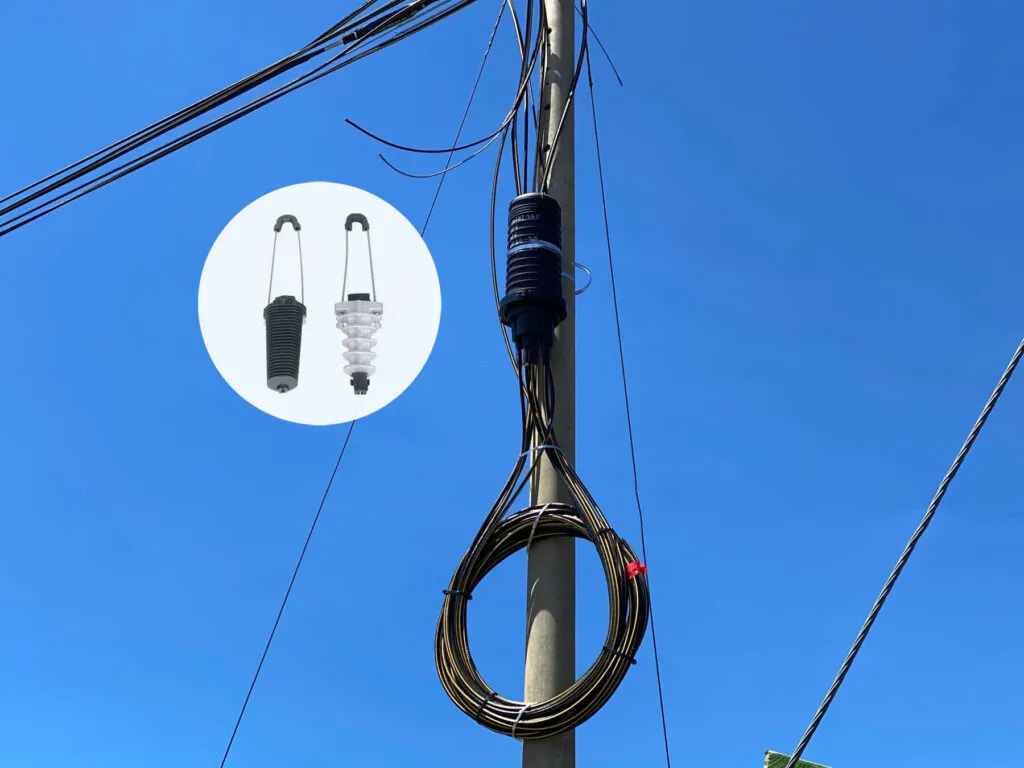
Even if the cable is perfect, the wind can kill it. Aeolian Vibration (high-frequency shaking) creates fatigue at the hanging point.
For spans over 100m, ABPTEL always recommends installing Spiral Vibration Dampers or Stockbridge Dampers to absorb this energy and protect the cable clamp interface.
Unsure about your RTS Calculation?
Don’t guess. Send us your span length, voltage level, and local weather data (Wind/Ice). Our engineers will simulate the load and recommend the exact specifications.
Get Free Calculation & Quote →Talk to ABPTEL
Looking for the right optical hardware for your AI data center, GPU cluster, or FTTA project? ABPTEL ships from Shenzhen with OEM/ODM support, fast lead times, and engineering-level pre-sales advice.
- 🔥 400G & 800G OSFP / QSFP-DD Transceivers — for AI training fabrics and hyperscale spine-leaf
- 📡 MPO / MTP High-Density Cabling — 12 / 24 / 32-fiber for high-density data centers
- ⚡ AOC & DAC Cables — short-reach GPU interconnects, OEM compatible
- 🧩 SFP / SFP+ / SFP28 / QSFP28 Modules — 1G to 100G optical transceivers
- 📋 Data Center Cabling Solutions — end-to-end design guide
- ❓ Read our FAQ — compatibility, polarity, lead time, MOQ
💬 Get a quote in 12 hours: Contact Candy · WhatsApp +86 188 1445 5697 · candy@abptel.com